Living Specs
Continuous Product Truth In The Age Of AI-Generated Code
A methodology for keeping product truth current, reviewed, and agent-readable as AI-assisted development changes the economics of software delivery.
Read the paper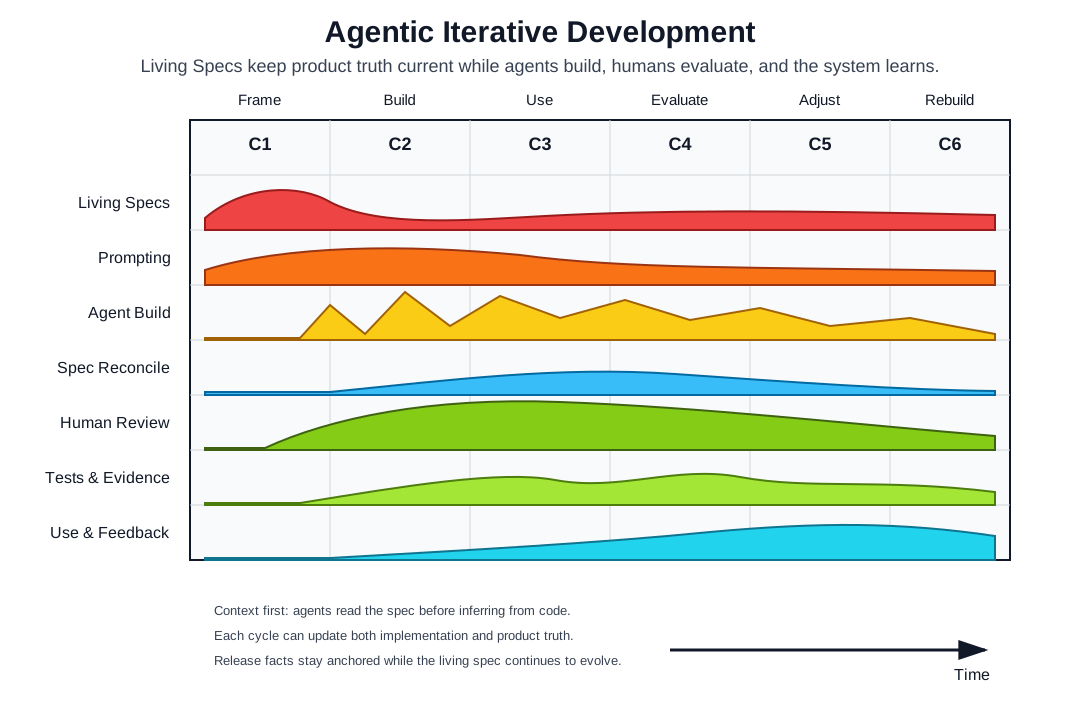
Engineering leadership, SaaS platforms, agentic development
Engineering leader for complex SaaS, product truth, and modernization.
I lead engineering teams through the messy work that matters: stabilising underperforming systems, rebuilding delivery confidence, modernising platforms, and turning product intent into durable execution.

Current Focus
I have been building software since the early 1980s, from early BASIC programs through internet startups and large-scale enterprise platforms. My professional engineering and senior technology leadership work spans fintech SaaS, invoice-to-cash platforms, hosting infrastructure, Kubernetes, M&A integration, international engineering teams, and operational quality systems. Before senior leadership, I was a hands-on architect and developer on business-critical platforms, large migrations, hosted Exchange, domain systems, and early web products.
Engineering transformation in real operating environments, not slideware.
Cloud-native SaaS platforms, CI/CD, observability, and delivery systems.
Agentic development practices that preserve product truth instead of scattering it through tickets and prompts.
Leadership habits that make engineering teams clearer, calmer, and more accountable.
Experience
Led engineering across EIPP and accounts receivable capabilities after acquisition, aligning teams, platform standards, roadmaps, and delivery practices.
Revitalised product and engineering execution for a financial SaaS business ahead of acquisition.
Built and led engineering and UI/UX teams delivering hosting products, platform migrations, a flagship partner network, and large-scale Kubernetes services.
Founded and built FootballNews.co.uk, then designed business-critical hosting systems including account migration, Exchange provisioning, domain APIs, and analytics data architecture.
Early computing
My software career started in the early 1980s with the Commodore VIC-20 and then the C64. I was not writing grand systems. I was writing small, useful programs that made real life more interesting.
One was for my father, who worked as a financial adviser. It forecast the future cost of ordinary things: bread, eggs, clothes, the everyday items people understood instantly. We printed the results as client booklets. An 800g sliced white loaf averaged 38p in 1984; by the mid-2020s the comparable ONS series was around £1.40. That felt like magic at the time: type in a few assumptions, press run, and suddenly inflation was not an abstract economic force. It was tomorrow's loaf of bread.
At school I wrote a charity collection tracker. Each class collected a few pence here and there every day. The software recorded the totals, but the fun part was the league table. Once the classes could see who was winning, the data stopped being admin and became a competition.
Then there was Subbuteo. My brother and I were obsessed with the table-top football game, so naturally the teams needed fixtures, player records, goal scorers, league tables, and a scoreboard with a countdown clock. In hindsight, it was a miniature football data platform hiding inside a childhood hobby. Years later, the same instinct resurfaced at full scale in FootballNews.co.uk.
ONS RPI average price series CZOH: Bread, white loaf, sliced, 800g.
Founder story
FootballNews.co.uk was one of the predominant internet news sources for UK football during the early dot-com era, tracking thousands of clubs across hundreds of leagues from the Premier League down through the local game. It was not just a website. We ran a working football newsroom.
Every Saturday, and on most weekdays, club secretaries from around the country sent results into our newsroom by email, fax, and telephone. We entered those results directly into the database, complete with goal scorers, red cards, league positions, upcoming fixtures, and match details.
From that data, the system generated league tables, statistics, match reports, news snippets, fixtures, and archive pages. The public site felt dynamic, but the web server mostly served pre-built static files generated from the database. Years later, I discovered that the BBC used the same broad pattern for high-volume publishing: do the expensive work ahead of time, then serve the content fast.
Writing
Continuous Product Truth In The Age Of AI-Generated Code
A methodology for keeping product truth current, reviewed, and agent-readable as AI-assisted development changes the economics of software delivery.
Read the paper